Why Your "Scoreboard" for Success Might Be Completely Wrong: Lessons from a Football Debacle and an Unexpected Translation
On Sunday, January 18th—the quiet afternoon just before the deep freeze settled in—the city of Houston found itself divided by two simultaneous, significant events. Each, in its own way, served as a profound illustration of what it actually means to be "blessed."
A few days prior, a faithful member of St. Cecilia’s had emailed me with a wry observation: "This Sunday, God is truly testing our faith to see which event we’re going to choose." The choice was stark: a rare playoff appearance for the Houston Texans against the New England Patriots, or an even rarer groundbreaking service for a new church building. Looking back at the final score of that game, I am tempted to tell those who stayed home that they chose poorly—that perhaps the "debacle" on the field was a form of divine correction.
But to say something so simple would be a disservice to the complexities of both life and faith. The blessings of God, the weight of our big decisions, and the metrics of a life well-lived are far more nuanced than a win-loss column or a binary choice between right and wrong. True blessing is not found in avoiding the "debacle"; it is found in how we carry ourselves through it.
The CJ Stroud Paradox: When a "Debacle" Becomes a Masterclass in Grace
On the biggest stage of his young career, Texans quarterback CJ Stroud turned in what was arguably the worst performance of his life. In our culture, it is common to "talk smack," to armchair quarterback from the safety of the sofa, and to hop off the bandwagon the moment the losses mount. It would have been easy to pile on, to point fingers, and to demand he be benched.
Yet, what followed the embarrassment on the field was a rare display of higher values—faith, friendship, loyalty, and commitment—that are often missing from the public square. Stroud did not deny the reality of the failure, but he reframed it through the lens of a larger calling. His coach, DeMeco Ryans, refused to join the critics or abandon his player.
"I did not play my best. But I’m going to respond. I’m going to keep my chest up, my chin up, and I’m going to keep battling forward for if God is before me, who can be against me. I’m going to rely on that." — CJ Stroud
"Keep your head up. I love you. I've got your back." — Coach DeMeco Ryans
The Patriots may have been ahead on the scoreboard when time expired, but the ultimate winners were those who realized that a fumble doesn't define a person. The real blessing that Sunday wasn't found in a trophy; it was found in the locker room grace and the community gathered at the groundbreaking and the subsequent reception at Rabbit Rabbit.
Stop Treating Blessings Like Door Prizes
We often use the word "blessed" as a synonym for "lucky" or "successful." We count clear victories and tangible gifts as obvious blessings, and we should certainly be grateful for them. However, in the Kingdom of God, the definition goes much deeper than the numbers on a personal scorecard.
Blessings are not door prizes that God tosses out to the faithful as a reward for good behavior. Instead, as one spiritual teacher recently noted, blessings are more like "life preservers God throws out to desperate souls struggling just to keep their heads above water."
This is the unexpected formula of faith. It is often the fumbles, the mistakes, and the turnovers that lead us to a deeper level of trust. This "nuanced" blessing is best captured in the paradoxes described by Richard Rohr:
We suffer to get well.
We surrender to win.
We die to live.
We give it away to keep it.
The "Peterson Pivot": How Great Work Often Starts by Feeling "Awful"
The late Eugene Peterson, who served as the senior pastor of Christ our King Presbyterian Church in Bel Air, Maryland, for nearly thirty years, provides a beautiful example of how failure precedes a breakthrough. In his retirement—a stage of life that proves qualifying for Medicare does not mean God is finished with you—Peterson was prodded by a persistent editor to translate the Bible into modern, idiomatic language.
The editor had been struck by Peterson’s 1982 book, Traveling Light, specifically his paraphrase of Galatians. Hesitantly, Peterson agreed to try the first ten chapters of Matthew. After four chapters, he stopped. He looked at his work and thought what many of us think of our first drafts: "This sucks." He later reflected that those initial chapters were "awful"—wooden, stilted, and contrived.
But in a moment of "what the heck," Peterson decided to stop trying so hard and simply "have some fun" with Chapter 5. In translating the Beatitudes, he finally "found his voice." That pivot, born out of the frustration of failure, resulted in The Message, a translation that has since changed the world.
The "End of the Rope" Manifesto: A New Definition of Being Blessed
When Peterson found his voice in that fifth chapter of Matthew, he gave us a roadmap for a life that is "blessed" regardless of external standings. His translation of the Beatitudes suggests that we are at our best when the world thinks we are at our worst:
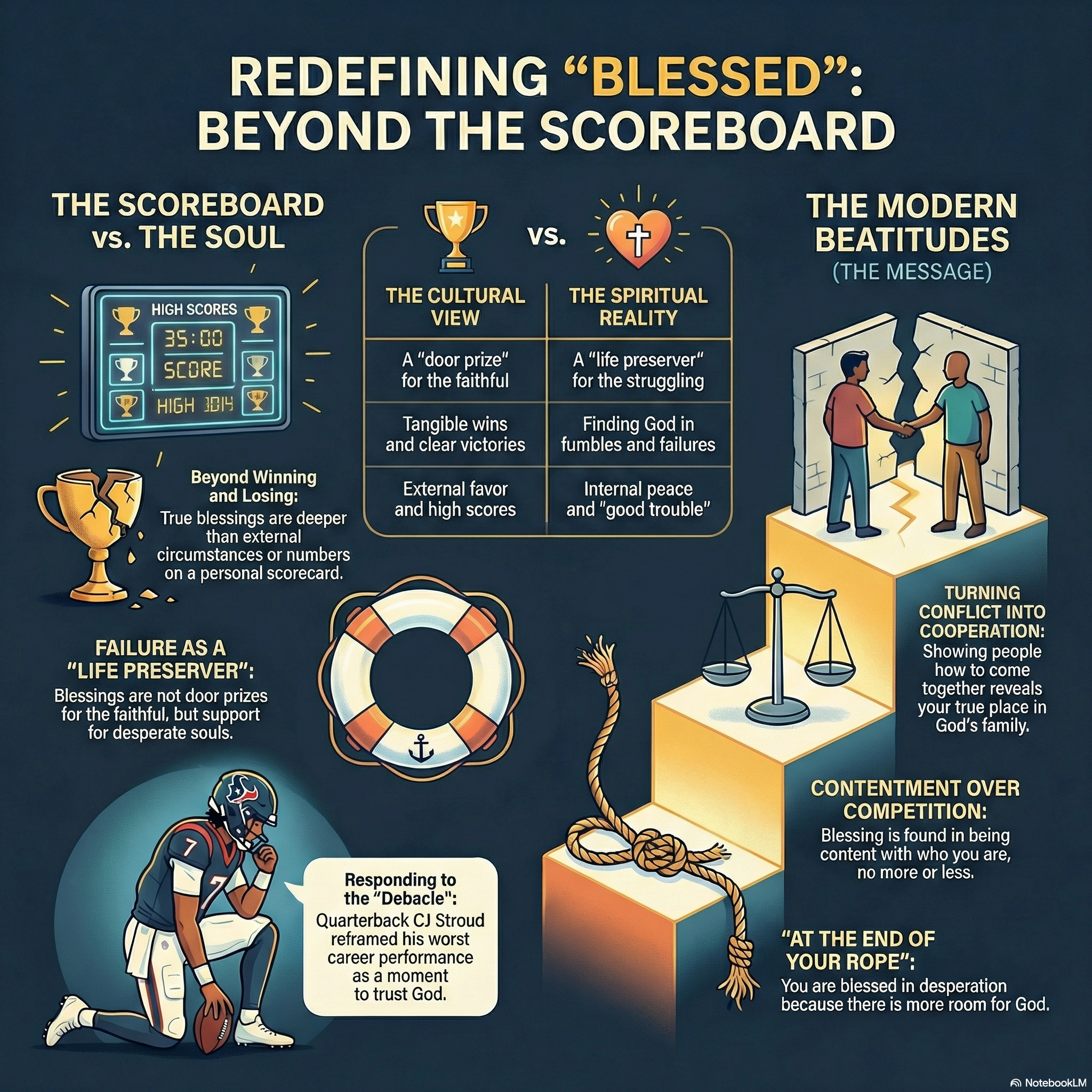
The End of the Rope: You are blessed when you’re at the end of your rope. When there is "less of you," there is finally room for "more of God."
The Gift of Loss: You are blessed when you feel you’ve lost what is most dear, because only then can you be completely embraced by the One most dear to you.
The Power of Contentment: You are blessed when you are content with just who you are. In that moment, you find yourselves the "proud owners of everything that cannot be bought."
Inside-Out Living: You are blessed when you get your "inside world"—your mind and heart—put right. Only then can you see God working in the outside world.
"You're blessed when your commitment to God provokes persecution. The persecution will drive you even deeper into God's heart."
To be put down or thrown out for the truth isn't a sign of a losing season; it’s a sign that you are in "good trouble." You are in the company of prophets and witnesses who understood that the truth is often too close for the comfort of the sidelines.
Conclusion: Redefining Your Scorecard
We must stop measuring our lives by the immediate roar of the crowd or the digits on a scoreboard. As James Thurber beautifully wrote, "Love is what you've been through with someone." The most profound blessings are often forged in what we have survived together—the losses, the fumbles, and the moments when we chose to have each other's backs when the world told us to walk away.
If you stopped looking at the scoreboard today—if you ignored the standings, the critics, and the external pressure to "win"—where would you find the life preserver God is throwing you? You might just find that you are most blessed exactly where you feel most defeated.